

How much should you actually spend on a home espresso machine?
One of the most common questions people ask when entering the world of home espresso is:
"How much should I actually spend on a home espresso machine?"
The internet is full of conflicting answers.
Some will say that €200 is enough.
Others claim that without €3000, there is no real espresso.
The truth, as usual, lies somewhere in between.
The good news is that today there are many more quality options than a few years ago. The bad news is that it's very easy to spend money on the wrong things.
In this guide, we will explain:
- what you realistically get in different price ranges,
- when a more expensive machine actually makes sense,
- why a grinder is often more important than the machine,
- how much to set aside for a grinder,
- and how to create a balanced setup that makes sense long-term.
The Biggest Mistake: All Budget on the Machine
When people first buy an espresso setup, they usually do one thing:
they spend almost their entire budget on the machine.
And then they buy an average grinder.
This is almost always the wrong approach.
With espresso:
- the grinder determines grinding consistency,
- affects extraction stability,
- helps you more easily repeat a good result,
- and often makes a bigger difference in the cup than a more expensive machine.
That's why a setup of:
- €1000 for the machine,
- plus €500 for the grinder,
very often yields better results than:
- €1500 for the machine,
- plus a weak grinder.
Therefore, a serious home espresso setup should be viewed as a whole.
What do you get in different price ranges?
Up to ~€500 — entry level and compromises
This range mostly includes:
- thermoblock machines,
- machines with smaller boilers,
- models with more plastic components,
- devices with limited temperature control,
- machines with weaker steam for milk drinks.
They can make perfectly decent espresso, but they often have:
- weaker steam,
- less stable temperature,
- less consistent pressure,
- limited potential for advancement,
- and a shorter lifespan compared to prosumer machines.
If you plan to make cappuccino occasionally and don't want to get too deep into the espresso hobby, this might be enough.
But if you already know you want a more serious specialty coffee setup, most users relatively quickly wish for an upgrade.
Around €1000–1500 — the sweet spot for most home barista users
This is where the serious prosumer world begins.
In this range, you get:
- PID temperature control,
- more robust construction,
- higher quality components,
- much better temperature stability,
- a more professional feel in operation,
- and a machine that can last for years.
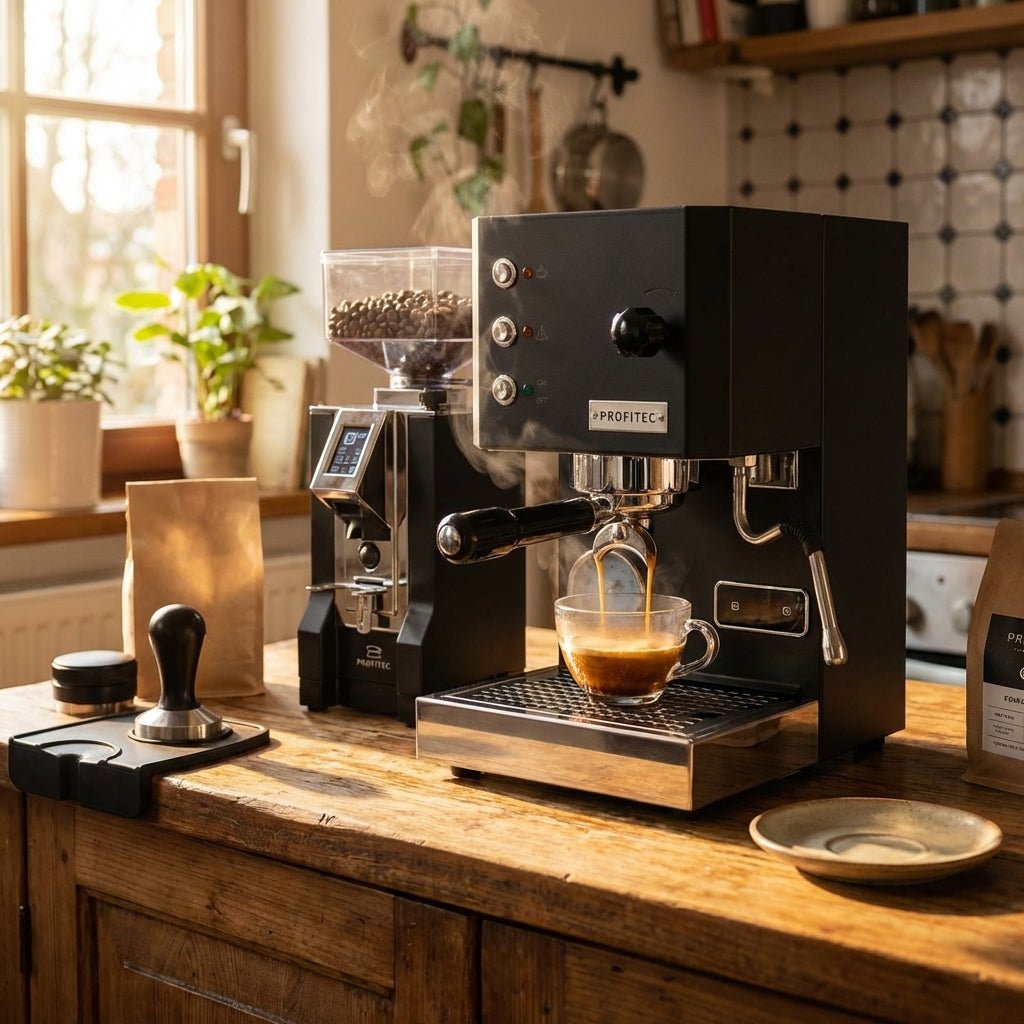
A model like the Profitec GO has become extremely popular precisely because it offers almost everything most home barista users actually need:
- excellent espresso quality,
- stable temperature,
- quality craftsmanship,
- fast heat-up,
- compact form,
- and serious potential for advancement.
For a large number of users — this is the best value for money.
Don't Forget the Grinder

In this budget, it makes much more sense to have:
- a good single boiler machine,
- a quality espresso grinder,
- good coffee,
- and a basic understanding of recipe adjustment.
In other words, it's better to have a balanced setup than an "overpowered" machine and a weak grinder.
An example of a very balanced setup is:
Profitec GO
+
Eureka Mignon Specialita
Such a setup can produce espresso quality very close to specialty cafes.
And for most users — that's more than enough.
When Does It Make Sense to Spend More?
More expensive machines generally don't make "twice as good coffee."
What you get is:
- better workflow,
- more control,
- stronger steam,
- more stable temperature,
- faster preparation of multiple coffees in a row,
- and a premium user experience.
This becomes especially important if:
- you make multiple milk drinks daily,
- you often make coffee for multiple people,
- you want maximum control over extraction,
- you want a machine that will remain relevant for a long time,
- or you simply enjoy top-tier equipment.
HX Machines — the next step
If you frequently make cappuccino or flat white, heat exchanger machines make a lot of sense.
A model like the Profitec Pro 400 allows for:
- simultaneous espresso and steam preparation,
- more powerful steam,
- a more stable workflow,
- and an experience closer to professional machines.
For many users, this is the point where home espresso starts to feel seriously "café-like."
Dual Boiler — when you want the maximum
Dual boiler systems represent the pinnacle of home espresso.
Machines like the Profitec RIDE offer:
- completely separate boilers,
- supreme temperature stability,
- serious steam power,
- faster preparation of multiple drinks in a row,
- and maximum control.
But it's important to understand:
this is not essential for making excellent espresso.
A dual boiler makes sense if:
- you often make multiple coffees in a row,
- you often make milk drinks,
- you want a premium workflow,
- you want the highest level of control,
- or you simply want an "endgame" setup.
How Much Should You Allocate for a Grinder?
A very rough, but useful guideline:
you should spend at least 30–50% of the machine's budget on the grinder.
Why?
Because the grinder directly affects:
- grinding quality,
- extraction consistency,
- flavor balance in the cup,
- ease of recipe adjustment,
- and repeatability of results.
One of the most popular choices in the premium home segment is the Eureka Mignon Single Dose PRO, especially for users who want maximum precision and experimentation with different specialty coffees.
Does a More Expensive Machine Make Better Espresso?
Yes — but not as much as people expect.
The difference between:
- a very bad setup,
- and a good setup,
is huge.
But the difference between:
- a good prosumer setup,
- and an ultra-premium setup,
is much smaller.
That's why for most users, it's much more important to:
- have a balanced setup,
- have a good grinder,
- use quality coffee,
- understand basic espresso recipes,
- and gain a little experience,
than to chase the most expensive machine.
What do we recommend to most home barista users?
If you want a serious home espresso setup without overdoing it:
Best balance of price and performance
Profitec GO
+
Eureka Mignon Specialita
This setup already falls deep into the prosumer category and can be a long-term solution for most users.
For users who want more control
ECM Classika PID
+
Eureka Single Dose PRO
Ideal for users who enjoy experimenting and the world of specialty coffee.
Ultimate home espresso setup
Profitec RIDE
+
Eureka Single dose PRO
Premium setup for users who want an experience very close to a professional specialty cafe at home.
Final conclusion
There is no universal answer to how much one "should" spend on an espresso machine.
But for most users:
- the best balance is between €1000 and €2500 for a complete setup,
- the grinder is just as important as the machine,
- a well-chosen single boiler setup can be quite sufficient,
- more expensive machines primarily offer better workflow and more control,
- and it's much more important to have a well-balanced setup than the most expensive machine.
The biggest mistake is not buying a "too weak" machine.
The biggest mistake is:
- buying an unbalanced setup,
- ignoring the grinder,
- or chasing specifications instead of real user experience.
When the setup is well-matched, even a relatively compact prosumer machine can provide espresso quality very close to serious specialty cafes.




1 comment
Dobar dan!
Želim da kupim aparat za kafu i pronašla sam set koji bi mi odgovarao, ali bih volela da najpre vidim kao izgleda i popričam sa nekim o tome jer nemam iskustva sa takvim aparatima.
Da li je moguće zakazati termin u vašem salonu?
Pozdrav,
Ivana Radovanović Novaković
Ivana Radovanović Novaković
Leave a comment
This site is protected by hCaptcha and the hCaptcha Privacy Policy and Terms of Service apply.