

Practical guide to home espresso machines
Making excellent espresso at home is no longer reserved for cafes. With the right espresso machine, a good grinder, and fresh coffee beans, you can enjoy specialty coffee shop-quality drinks every morning. How do you choose the right model for home use? In this guide, we explain key technical terms (PID control, boiler types, group types, pumps) and provide recommendations from trusted brands such as Rocket, Rancilio, Profitec, Lelit, ECM, and La Marzocco – all from Brew Society's offerings. Our goal is to help you connect your needs with our products through educational advice. Read on to find out what to look for and which models might be ideal for your home espresso bar.
Key Features of Home Espresso Machines
-
Boiler type (single vs. dual boiler vs. heat exchanger – HX): Home machines use different heating systems. Single boiler machines have one smaller boiler that alternately serves for espresso preparation and milk steaming. This means you cannot extract espresso and steam milk simultaneously; you must wait for the transition from one function to the other and for the temperature to stabilize. Their advantages are often compact size and lower price, but they are less practical for preparing multiple milk-based drinks in a row. Heat Exchanger (HX) machines have one larger boiler (for steam) through which a tube with water for espresso passes – allowing for simultaneous coffee brewing and milk steaming. The water for espresso is heated by a heat exchanger inside the boiler, which, with proper management (e.g., briefly purging water before extraction to stabilize the temperature), yields consistent results. Dual boiler machines have two separate boilers – one for espresso water and one for steam. This is an ideal solution for maximum control: parallel extraction and milk frothing, precise temperature regulation for espresso independent of steam, and faster machine recovery during intensive use. Dual boiler machines usually have a higher price but provide superior temperature consistency and are suitable for demanding users or larger households where multiple coffees are made in a row.
-
PID temperature control: Many modern machines feature PID controllers (Proportional-Integral-Derivative) that electronically maintain a set boiler temperature very precisely. PID control eliminates temperature variations present in classic thermostats or pressurestats. For the user, this means more stable water temperature during extraction and the ability for fine-tuning – which translates to a more consistent taste in the cup of espresso. For example, models like the Lelit Mara X have a dual-probe PID system with three preset temperatures for espresso, allowing you to choose warmer or cooler extraction depending on the coffee. PID also facilitates quick adaptation when switching from espresso mode to steam mode on HX machines – the Mara X even allows the user to switch between prioritizing faster heating for steam or maintaining the ideal temperature for coffee brewing. In dual boiler machines, PID usually independently controls each boiler (e.g., the Rancilio Silvia Pro has two PIDs – one for the coffee boiler and one for the steam boiler – thus maintaining the stability required by home baristas). In short, PID is a desirable feature if you are looking for serious control and consistency – it has become standard in higher-end home machines.
-
Group (brew group): The group head is the part of the machine where the portafilter attaches and through which extraction actually flows. There are various group designs, but the two most common in home/prosumer machines are the classic E61 group and saturated (integrated) groups. The E61 group is a legendary design from 1961 (Faema) that is still used today on many high-end machines (Rocket, ECM, Profitec, Lelit, etc.). It is a massive 4 kg brass group through which hot water from the boiler continuously circulates via thermosiphon, keeping the group hot. The advantage of the E61 is excellent thermal stability – the heavy mass retains heat, and constant water flow ensures uniform temperature during extraction. Also, the E61 inherently provides a short mechanical pre-infusion: when you start extraction, water soaks the coffee for a few seconds before reaching full pressure, which aids better extraction. The disadvantage of the E61 is that it requires a longer warm-up time (often 20-30 minutes for the group to reach full temperature) and the entire assembly is somewhat heavy for super compact machines. A saturated group is an approach used by brands like La Marzocco, etc. – the group is structurally connected to the boiler or heater, so it heats up faster and maintains a stable temperature with less metal mass. For example, the La Marzocco Linea Mini has an integrated group connected to a small coffee boiler, allowing for rapid heating and very precise temperature control within a few tenths of a degree. Saturated groups are often seen on high-end dual-boiler machines (LM, Rancilio Silvia Pro X has a similar concept) and are characterized by being ready for operation faster and maintaining consistency with fewer fluctuations. In practice, both systems – a well-heated E61 or a saturated group – can produce excellent espresso at home, especially when the machine has PID control. It is important to understand that water temperature and group stability affect extraction: a machine that keeps the group hot (either by mass or by heater) will help you achieve repetitive results more easily, cup after cup.
-
Pump (water pressure): Home machines mostly use electric pumps to generate the standard ~9 bar pressure for espresso. There are two main types: vibration pumps and rotary pumps. A vibration pump (vibrating diaphragm) is small, affordable, and found in most home models due to its simplicity. It works on the principle of an electromagnet that vibrates and pushes water; the effect is strong pressure with a characteristic buzzing sound during operation. The advantage of a vibration pump is that it is cheaper and smaller, but it produces more noise and has a somewhat shorter lifespan compared to rotary pumps. Most reservoir machines (which use water from an internal container) have a vibration pump. For example, the Rocket Appartamento and Lelit Mara X have vibration pumps, although manufacturers sometimes implement rubber mounts and dampeners to reduce noise – the Mara X has an almost silent vibration pump thanks to a special housing design.
-
A rotary pump is larger, similar to those in commercial machines; it uses vanes inside a chamber to continuously push water. Its advantages are quieter operation, greater reliability, and the possibility of direct connection to plumbing (plumb-in) as it can easily draw water from mains pressure. Rotary pumps are found on more expensive models – often higher-end dual boiler machines. For example, the ECM Synchronika has a built-in rotary pump, which makes it very quiet and offers the option of using an internal reservoir or connecting the machine to a fixed water supply. Similarly, the Rocket R Cinquantotto (R58) uses a rotary pump, which is a significant convenience for home enthusiasts who value quietness and connection flexibility. In practice, both pumps provide the necessary pressure for espresso – the quality of the cup will not directly depend on the pump type – but the user experience will be different. If the machine is in the kitchen where everyone is sleeping, the quieter operation of a rotary pump might be important; if you make a few coffees a day and noise doesn't bother you, a vibration pump will do the job just fine. It's important that the machine has good over-pressure protection (OPV valve) set to ~9-10 bar, so that the pressure on the coffee is optimal regardless of the pump.
-
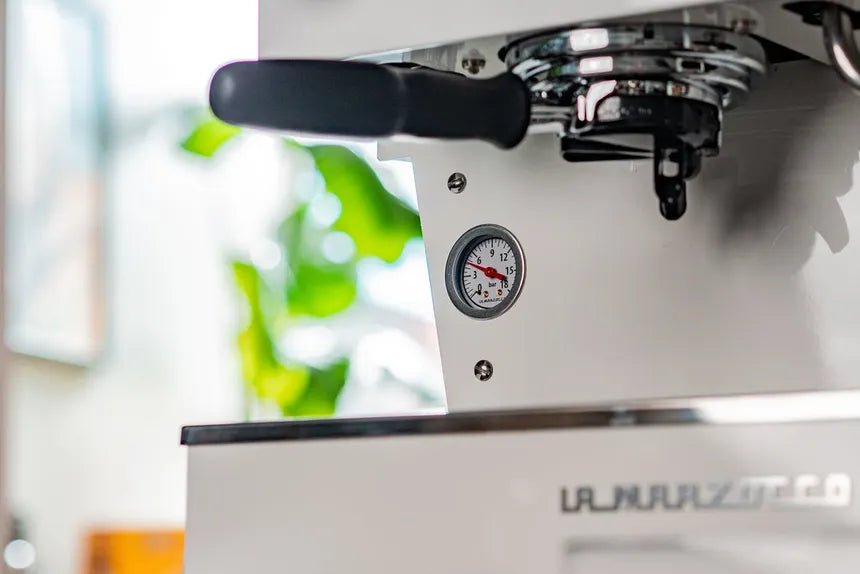
Other features and practical tips: Pay attention to other details that make life with an espresso machine easier. Water reservoir capacity (the larger, the less often you refill; standard is around 2 liters for most home models). Low water indicator – a useful feature to protect the pump from running dry (some models have automatic heater/pump shutdown when water runs out). Pressure gauges – many machines have dual gauges: one for boiler/steam pressure, the other for pump pressure during extraction. This helps you visually monitor if everything is in order (e.g., a pressure drop can indicate channeling in the coffee). Pre-infusion – some machines offer programmable pre-infusion (e.g., electronic on Lelit Bianca), while E61 groups have that natural soak effect. Essentially, pre-infusion aids the espresso process by soaking the coffee at lower pressure for a few seconds before full extraction, which can contribute to better flavor. Steam power – if you enjoy latte art and cappuccinos, consider the size of the steam boiler and the declared steam pressure. More powerful machines have ~2 bar of pressure in the steam boiler, allowing for milk frothing like commercial machines. Smaller single boiler models will have weaker or slower steam, which doesn't mean you can't froth milk, but it will take more time and skill. Also, "no-burn" steam wands (insulated to prevent burns) are a nice convenience on many premium models. Finally, don't forget: a quality coffee grinder is just as important an investment as the espresso machine. No machine, no matter how expensive, will make good espresso without fresh and properly ground coffee. So, include a good grinder in your budget (brands like Eureka, also available from Brew Society, specialize in espresso grinders). Now that we've covered the basics, let's look at recommended espresso machine models in different categories – from affordable classics for beginner enthusiasts to high-end machines that will satisfy even the most demanding home baristas.
Recommended Models from Our Offer (by User Needs)
Below, we provide suggestions for models from proven brands available in the Brew Society offer. We have categorized them by user profile and purpose, noting that all these machines can prepare excellent espresso – the differences lie in the degree of automation, the speed of preparing multiple drinks, and the additional options they offer. Read the description of each model to see if its characteristics match your habits and wishes.
For beginner espresso enthusiasts (single boiler classics)
If you are just entering the world of home espresso and are looking for your first serious machine, single boiler models offer an excellent value for money with slightly simpler operation. They are an ideal choice for those who primarily drink espresso or small quantities of milk-based beverages.
-
Rancilio Silvia – A legendary machine that has been produced for over 25 years without significant changes, which speaks volumes about its quality and popularity. The Silvia is robust, with a metal casing and commercial-quality internal components – it features a 58 mm professional portafilter (the same diameter as in a cafe) and a three-way solenoid valve that relieves pressure from the portafilter after extraction for a dry puck and cleanliness. In practice, this means that with good technique, you can truly get cafe-quality espresso at home and immediately remove the puck without a mess. The Silvia has a brass boiler of ~0.3 L that serves both for coffee and steam. This means that after espresso, you'll wait about 1 minute for the boiler to heat up to steaming temperature (and vice versa, to cool down from steam to coffee), but in return, you get a compact machine (~24 cm wide) that fits into any kitchen. The Silvia does not have a built-in PID (temperature is controlled by a thermostat), so it requires a little skill in "temperature surfing" – practically, you wait about 30 seconds after the thermostat light turns off to start extraction, in order to catch a stable temperature interval. With a little practice, users achieve excellent results – an "old school" machine that delivers a lot. Also, the steam wand is professionally designed and very powerful for its class, so with appropriate technique, you can create excellent microfoam for cappuccino. The Rancilio Silvia is a common choice for enthusiasts as their first "real" espresso machine – it requires engagement and learning, but rewards with exceptional espresso and longevity (it's known as a "tank" among machines, often lasting decades). Note: there is also a Silvia Pro X version that adds a dual-boiler, PID control, and other conveniences in the same format – for users who like the Silvia's concept but want faster cappuccino preparation and precise temperature control. The Silvia Pro is, of course, more expensive and falls into the next category, but it's worth knowing that an upgrade path exists.
-
Lelit Victoria / Glenda (Elizabeth) / Anita series – In addition to Rancilio, the Italian company Lelit offers several models in the entry-level class that are popular among home baristas. They are characterized by the fact that most have a built-in PID controller and heat up faster. For example, the Lelit Victoria is an elegant, compact machine with a single boiler of ~0.3 L (brass), but unlike the Silvia, it comes factory-equipped with PID control and the option of programmable pre-infusion. The Lelit PL41TEM Anna model is similar – a small machine with a ~250 ml brass boiler and PID, excellent for focusing on espresso with occasional cappuccinos. The Lelit Elizabeth (PL92) goes a step further – it's a dual boiler in a compact casing for users who want faster switching to steam, but it falls into a higher price category. Generally, Lelit machines are known for their good value for money and performance – you get many advanced features (PID, programmability) in a home machine more affordably than competitors. Their drawback is that they are lighter, with less metal mass, so temperature stability is slightly lower than, for example, E61 machines. However, for the entry-level, this will not be an obstacle – Lelit provides a nice introduction to the world of espresso with minimal compromise. If you choose Lelit, pay attention to the portafilter diameter – most of them are 57 mm (slightly smaller than the standard 58 mm), which practically has no impact on quality, but means you need to acquire appropriate accessories (e.g., a 57 mm tamper instead of 58).

(Note: The Gaggia Classic is another famous "entry-level" single boiler machine, but since Gaggia is not among the brands on the Brew Society list, we focused on Rancilio and Lelit. This concludes the story that in this class, you generally get a robust machine of modest dimensions that requires a bit more "manual" work from the user – which true enthusiasts certainly don't mind.)
For cappuccino lovers and greater comfort (HX and smaller mid-range dual boiler machines)
If you plan to make multiple milk drinks in a row, frequently make two lattes/cappuccinos in the morning, or simply want less waiting and more built-in technology – it's worth considering heat exchanger (HX) machines or compact dual boilers. These models form the core of the prosumer category: they are designed for demanding home users and offer near-cafe performance, but still in a home format and at a moderate price. They are distinguished by better temperature stability, the ability to make coffee and steam simultaneously, often PID control, and richer features (pressure gauges, larger reservoirs, higher quality housing). Here are a few proven mid-range models:
-
Lelit Mara X – "Espresso the Italian way, adapted for the home barista" could be the slogan for the Mara X. This compact HX machine, only 22 cm wide, manages to pack a full-profile E61 group head and a range of advanced solutions into a small casing. The Mara X has a 1.8 L stainless steel boiler and a thermosiphon system for the E61 group, which means it maintains a very stable temperature and allows for simultaneous espresso extraction and milk steaming, like all HX models. What sets the Mara X apart from classic HX machines is its dual PID system with two temperature sensors and special electronics optimized for home use. The user doesn't have to worry about the so-called "cooling flush" ritual – the Mara X ensures the temperature is set for optimal espresso through one of three selected temperatures (warm ~92°C, hot ~94°C, extra hot ~96°C at the group head level). And not only that – below the drip tray, there's a switch that allows you to set the machine to operate in steam priority mode (for situations when you're making multiple milk drinks in a row – it keeps the boiler slightly hotter for stronger steam), or coffee priority mode (for regular espresso sessions – it maintains a stable optimal temperature for extraction). Practically, Lelit has "tamed" the HX system to be as user-friendly and forgiving as possible. The Mara X has a built-in pressure gauge for pump pressure, a low water indicator, a quiet vibratory pump with special dampening, cool-touch steam and hot water wands – complete equipment. When heated up (~20 min due to the E61 mass), it produces espresso of a quality very similar to much more expensive machines. Steam power is solid: the 1.8L boiler and 1400 W heater provide about 1.5-1.6 bar of pressure, which is sufficient for reasonably fast milk frothing (about 30 seconds per serving). If you love Italian design and want the best possible espresso in the smallest package, the Mara X is an excellent choice. In terms of price and features, it competes with the Rocket Appartamento but offers the advantage of PID control and temperature options. Its drawback might be that it doesn't have a completely separate boiler for coffee – but unless you're making 10 coffees in a row, this won't be noticeable. The Mara X is one of the most praised HX machines on forums in the last few years, as it successfully combines compactness, performance, and affordability.
-
Rocket Appartamento – One of the most popular prosumer HX machines in the world, the Rocket Appartamento is synonymous with style and quality in a home espresso environment. Handcrafted in Italy, with distinctive circular side panel cutouts (available with copper or white circles), this machine elegantly brings café-quality espresso into the home. At its heart is a 1.8 L copper boiler with an integrated heat exchanger, allowing for simultaneous coffee extraction and milk steaming. Copper as a material contributes to excellent thermal stability and has antimicrobial properties, and the insulated boiler retains heat with less energy consumption. Rocket uses an E61 group (full-sized, of course), meaning thermal stability is excellent – the heavy "floating" brass parts in the group maintain an even temperature and help form a rich crema on the espresso. Once heated, the Appartamento can easily produce multiple shots in a row with consistent quality, whether you're making espresso for guests or a round of cappuccinos. The machine has a boiler pressure gauge so you know when it's ready to work (green range around 1-1.2 bar), a professional 58 mm portafilter, a hot water valve (for Americano or tea), and a no-burn steam wand with a 2-hole tip that allows for good control when texturing milk. It should be noted that the Appartamento does not have a PID controller – temperature is regulated by a classic pressure stat, which works perfectly fine in practice, but means there is no digital display or fine temperature adjustment options. Rocket compensates for this with very good thermostats and a stable thermosiphon group, so the in-cup temperature is reliable. For advanced users, this also means you may need to manually perform a short flush before extraction if the machine has been heated and idle for a long time (which is standard routine for HX machines). The Appartamento also does not have the option for direct water connection – it exclusively uses an internal 2.3 L reservoir (which is practically sufficient). And the vibration pump is standard (Rocket Giotto and Mozzafiato series offer models with rotary pumps, but the Appartamento does not). What you get is a proven, robust machine that graces many coffee lovers' kitchens. The build quality is superb: polished stainless steel casing, copper pipes and brass fittings inside, all hand-assembled in Turin. The Rocket Appartamento is often the choice for those who want "to buy a serious machine once and have it last" – with minimal care, this machine will serve you for years. In short: a classic E61 HX in a beautiful package, for those who appreciate both form and function. (A small note: Rocket also offers Cronometro models with additional features – Type V has a PID controller and digital timer, and Type R adds a rotary pump and plumbing option. These are variations of the Giotto and Mozzafiato models, which are a step above the Appartamento. If the Rocket brand appeals to you, it's worth considering these variants for comparison.)
- Rancilio Silvia Pro X – We already mentioned the upgraded Silvia, and it falls into this category because it offers two boilers in a similarly sized housing. Rancilio implemented a 0.3 L coffee boiler + 1 L steam boiler in the Silvia Pro model, both with separate heaters and PID control. The result is a machine that retains the recognizable Silvia look and robust build quality, but now allows for simultaneous extraction and milk steaming, with precise temperature regulation on a digital display. The Silvia Pro also has useful additions such as a built-in shot timer to track extraction time, automatic start-up settings (wake-up timer), and improved boiler insulation. The group is thermally connected to the coffee boiler (saturated mini-group), which provides excellent temperature stability shot after shot. For fans of the original Silvia who considered modifications – the Silvia Pro X practically comes with all mods factory-installed: PID, dual-boiler, better steam wand, shot timer, pre-infusion (the Silvia Pro X model has a short pre-infusion option). It should be noted that the Silvia Pro's price is on par with larger HX machines; so you're paying for compactness and a reputable brand. However, you still get a durable, reliable machine with commercial-grade construction (Rancilio uses many parts from its professional series in the Silvia Pro, e.g., brass brew block, quality OPV valve, 58 mm metal tamper included, etc.). For someone who wants small dimensions but big capabilities, and perhaps doesn't have space for a wider E61 machine, the Silvia Pro X will be the perfect solution. It is capable of making cappuccinos consecutively without waiting and provides reliable espresso temperature every time – practically a "coffee machine on steroids" compared to the classic Silvia.
(There are other notable models in this middle category – e.g., the Profitec Pro 300 is a compact dual-boiler with a similar philosophy to the Silvia Pro; then the ECM Mechanika IV/Technika and Profitec Pro 500 – these are HX machines similar to Rocket; Lelit Elizabeth – a dual boiler with many features in a small package, etc. However, to avoid broadening too much, we've focused on a few representative ones. Essentially, the mid-range offers a quantum leap in convenience compared to a single boiler, at a price that is still far from the most expensive machines. If you love cappuccino and want to prepare it quickly in the morning for yourself and your partner – this class is the best choice.)
For the Most Demanding Home Baristas (Dual Boiler, Rotary Pump – Premium Segment)
Finally, for those who expect the maximum from a home machine without compromise, there are premium models that practically bring café-level coffee machine performance to your kitchen countertop. They are characterized by top-notch craftsmanship, two stainless steel boilers, precise PID (often with many programmable options), a rotary pump (quiet and powerful), the ability to connect to a water line, large reservoirs, strong steam capacity (often 2+ bars of steaming pressure), and various accessories (timers, light indicators, and even flow control paddles). These machines are intended for enthusiasts who are willing to invest serious money for limitless espresso at home – whether they want to experiment with every aspect of extraction or simply enjoy the best possible cappuccino every morning, without waiting and with a luxurious user experience. We present a few top models from the selection:
-
ECM Synchronika – In the world of home espresso machines, the ECM Synchronika is considered the gold standard of dual boiler machines. Designed in Germany and handcrafted in Italy, the Synchronika combines German precision and Italian artisanal tradition. It features two stainless steel boilers (0.75 L for coffee, 2 L for steam) with independent PID controls, allowing temperature adjustment for espresso and steam via the front OLED display (the newer Synchronika II version also has more programmable functions and faster heating). What sets it apart is its rotary pump and the option to choose a water source – you can use the internal 3 L reservoir or directly connect the machine to a water line, ideal for home coffee corners. The build quality is uncompromising: a brushed stainless steel casing with a finish without visible seams, attention to detail (the interior of the plastic water tank is designed not to vibrate, the valve handles are joystick type for faster opening, and every screw inside is aligned – an obsession with detail that ECM cultivates). Thermal stability is supreme: in addition to the PID, the Synchronika also has heaters in the group (active heating of the E61 head) so the entire monster heats up in about 10 minutes, which is extremely fast for a machine of its class. Steam power – enormous: 2 bars of pressure, like in a café, means you can steam milk for 2-3 drinks in one cycle and very quickly (dry steam, perfect for latte art). Synchronika also offers soft pre-infusion (through E61 and line pressure if connected to water) and an optional kit for flow control (manual adjustment of flow/pressure during extraction for advanced profiles). When using it, everything feels refined: from the smoothly gliding valve handles to the almost silent hum of the pump – it's clear that this is the "Mercedes" among home machines. Of course, the price reflects such status, but for those who seek the best, the Synchronika is at the top of the list. Professionals describe it as an "engineering marvel that stands at the forefront of the home espresso market", with cafe-quality steam (2 bars), PID temperature precision, and water line connectivity – every enthusiast's dream. If your budget allows, you'll hardly find anything better than this – perhaps only the next on the list, Profitec (ECM's sister company) or La Marzocco, but there we enter the realm of personal brand preferences.
-

-
Profitec Pro 600 / 700 – Profitec is actually a sister brand of ECM (same owners), so many components are shared. Profitec Pro 600 is a dual boiler machine very similar to the Synchronika, with slightly less "embellishment." It features dual PID control, two boilers (0.75 L and 1 L), an E61 group, optional flow control lever, dual pressure gauges, and a stainless steel casing. Differences: The Pro 600 is slightly more compact and comes standard with a vibratory pump (quieter than smaller machines, but not as quiet as a rotary pump). Profitec Pro 700 is practically a twin of the Synchronika – dual boiler, rotary pump, plumb-in or reservoir option, and a slightly more "industrial" design (round buttons instead of joystick valves, a slightly simpler finish). Essentially, if you want ECM quality and to save a few hundred euros, the Pro 700 delivers identical performance, sacrificing only a few aesthetic details. It's also worth mentioning the Profitec Pro 800 – this is a machine for true purists: a dual boiler with a manual lever group (spring-loaded), for those who want to experience traditional lever espresso extraction – but that's already an exotic choice. In any case, Profitec as a brand is known for exceptional reliability and simplicity – their slogan is "Everything you need, nothing you don’t." There are no superfluous electronics except for the PID; the focus is on stability and quality. For example, the Pro 600 achieves high user ratings because it has very strong steam (2 bar) for its size, and the dual PID also allows for single boiler operation if desired (you can turn off the steam boiler when not in use). In operation, the Pro series is minimalistic – there are no displays except for a small PID screen, but what it does, it does flawlessly. Essentially, when choosing between ECM and Profitec, you're choosing more about aesthetics and a few minor details, while the "heart" of both machines is the same. Anyone who appreciates the engineering approach of "form follows function" will love Profitec.
-
Lelit Bianca – If you ask in espresso circles which machine offers the most control and possibilities for an experienced enthusiast, the name Bianca will be at the top. The Lelit Bianca is a dual boiler E61 machine that adds a specific feature compared to those mentioned above: a manual paddle for controlling water flow through the group. On top of the E61 group head, there is a wooden lever that allows the user to manually regulate the flow (and thus pressure) during extraction – practically built-in flow profiling without the need for mods. This means you can manually perform advanced extraction recipes: for example, a longer pre-infusion with lower pressure, then gradually increasing to 9 bar, then reducing at the end – all to extract maximum flavor from specific coffees. Bianca also features the Lelit Control Center (LCC) – a digital control system that allows for additional adjustments via the display (e.g., programming a low flow rate for the first few seconds of the shot, automatic shutdown of the steam boiler to save energy, programming pre-infusion by timer instead of manually, etc.). Of course, the core is still classic: two separate stainless steel boilers (0.8 L for coffee, 1.5 L for steam), PID control, strong steam power (~1.5 bar, easy frothing), rotary pump, and the option to operate with a reservoir (cleverly placed externally and can be moved behind or to the side of the machine) or connected to plumbingl. Bianca comes in a luxurious package – all details are made of walnut wood (levers, paddle handle, feet, portafilter handles), and the stainless steel finish is top-notch. What users praise is that Bianca combines engineering innovation with barista passion: you can use it very simply (ignore the paddle, and it works like any E61 DB machine with a set pressure), or you can dive deep into pressure profiling. The espresso quality is professional level – dual boiler and E61 ensure temperature stability, so every parameter is easily controlled. A unique advantage is the movable reservoir – you can attach it magnetically to the left, right side, or back, which helps if you need to place the machine in a tight space. Bianca's drawbacks… well, there are no major drawbacks other than that it requires an investment like other premium models. Some might say the look is a bit old-school (cubist stainless design with wood), but many find it beautiful. With this model, Lelit has proven it can compete with bigger players – Bianca is often compared to Synchronika and Linea Mini, and it certainly rivals them in performance, often even surpassing them in terms of features. For the true home enthusiast who wants a tool that will grow with their skills, there is hardly a better recommendation than Bianca.

-
La Marzocco Linea Mini – Finally, let's mention the "holy grail" of home espresso machines. When a passionate coffee lover truly insists on having the same equipment that baristas use in specialty coffee shops at home, the Italian La Marzocco has the answer – the Linea Mini model. The legendary Linea Classic (commercial two-group) has been the workhorse of specialty coffee shops worldwide for decades, and the Linea Mini represents its scaled-down, single-group version, designed specifically for home use. However, "scaled-down" is a relative term – the Linea Mini weighs ~30 kg and has quite large boilers inside. The configuration is specific: dual boiler + integrated saturated group. It has a brew boiler of ~170 ml that is actually integrated with the group head (the so-called integrated brew group design – which provides phenomenal temperature stability), and a large 3.5 L steam boiler that provides an inexhaustible amount of commercial-quality steam. La Marzocco uses PID control for temperature (adjusted via an app or an internal dial – discreetly, as they wanted to maintain a retro look without a display), so you can select the extraction temperature to the precise degree. It features an integrated rotary pump, which is very quiet, although interestingly, it doesn't come standard with a direct water connection option (a separate kit is an add-on – because LM assumed home users would mostly use the reservoir). Operation is semi-manual: the lever on the side (the classic La Marzocco paddle) merely turns the water flow on/off – it is not intended for pressure profiling like the Lelit Bianca, but it allows for a pre-wetting function (when turned slightly, water starts to saturate the coffee without full pressure). Craftsmanship is, as expected, uncompromising: hand-built in Florence, each Linea Mini undergoes rigorous testing. The casing is made of thick steel, available in various colors (classic stainless, black, red, yellow, white...), the design is cubist minimalist – tastes are subjective, but many love its industrial charm that evokes true commercial coffee equipment. Performance: The Linea Mini delivers an identical espresso shot to a large commercial La Marzocco – temperature and pressure stability are top-notch, each subsequent cup is the same as the last, with no fluctuations. You will practically never "run out" of steam – you can make 10 cappuccinos in a row if needed, and it will deliver. Drawbacks? Well, the price… The Linea Mini is significantly more expensive than all the previously mentioned machines (it's an investment comparable to a used car). Also, it lacks some of the fancy home additions – for example, there's no built-in extraction timer on the basic version (newer models have an updated panel with digital time readings and some additional functions). However, the point of the Linea Mini isn't gadgets, but tireless quality. If you are one of those who say "coffee is my life" and are serious about investing, this machine can literally open a small coffee shop, let alone satisfy home needs. La Marzocco is also a status symbol among baristas – having a Linea Mini at home is like owning a Porsche 911 in the garage. Of course, such a device makes sense mainly for those for whom budget is not an issue and who truly want a professional espresso bar at home. For most enthusiasts, half-price models (like the Synchronika or Bianca we described) will serve equally well, but for those who want "the best of the best", we cannot fail to mention the Linea Mini as the crown jewel of the offerings.

(Besides the Linea Mini, La Marzocco also offers the GS3 model, which is even more expensive and sophisticated, but it is very rare for use outside of professional environments. We should also mention that Rocket has its R Nine One model with similar aspirations – with integrated pressure profiling and so on – but these are already exotic machines beyond the reach of the average user.)
Conclusion – Find your ideal machine
From the classic Rancilio Silvia that introduces you to the world of home espresso making, through compact "home barista" machines like Lelit and Rocket, all the way to premium machines that rival cafe-grade equipment, the options are numerous. The key is to consider your own needs and habits: how many coffees per day, whether predominantly espresso or also milk drinks, how much you are willing to learn and operate manually, what your budget and space are. We hope that this guide has clarified the basic concepts (PID, boilers, pumps, groups) and introduced you to the advantages of each range of devices. All the mentioned brands – Rocket, Rancilio, Profitec, Lelit, ECM, La Marzocco – are known for quality, and each of these models has its strengths.
A slight recommendation for the end: Always invest in a good grinder and fresh coffee – espresso is a whole of equipment, beans, and skill. And when you're ready to choose, check out our Brew Society espresso machine offerings. Whether you're looking for an affordable model to start with or a dream top-tier machine, we're here to help you with advice and selection. With the right choice, every morning espresso at home can become a small ritual of enjoyment – you're the barista, in your own kitchen, with equipment that perfectly suits you. Good luck in your search for the ideal home espresso machine and enjoy every sip!





Leave a comment
This site is protected by hCaptcha and the hCaptcha Privacy Policy and Terms of Service apply.