

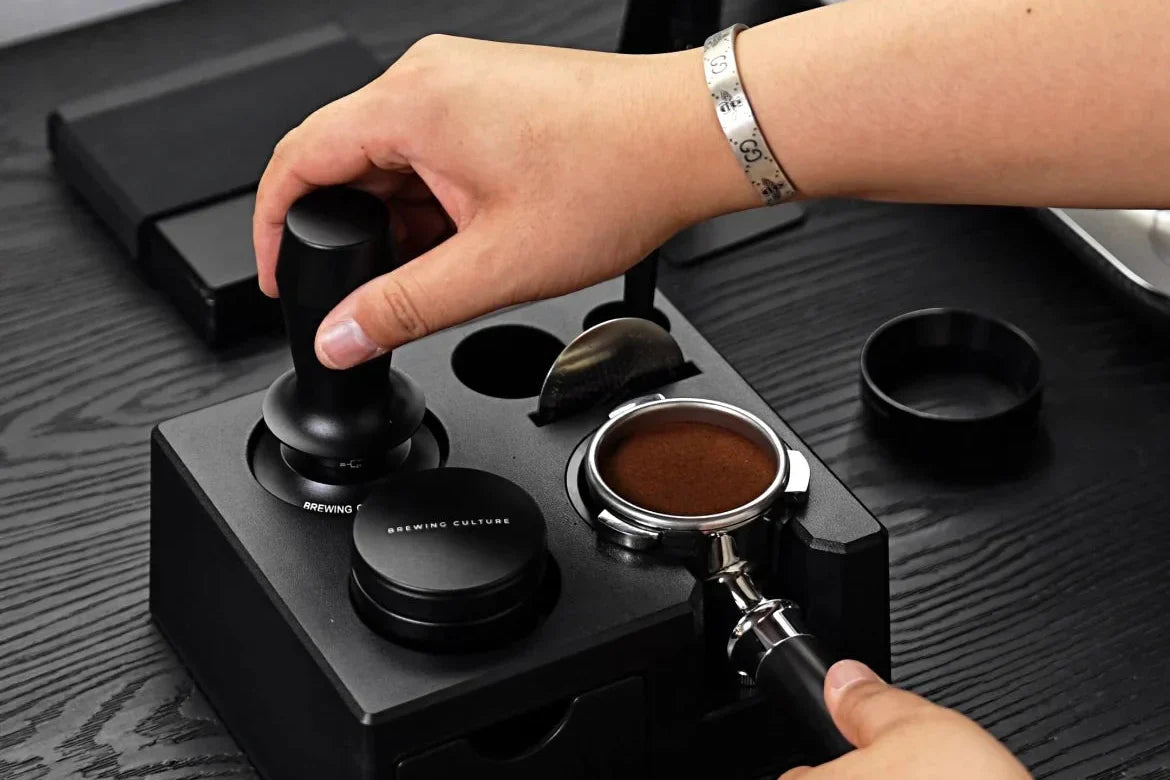
The importance of espresso accessories for home preparation
Home espresso preparation can be truly high-quality with the right approach and appropriate barista accessories. In addition to a good machine and grinder, additional espresso equipment plays a crucial role in achieving a consistent, delicious beverage. Below, we provide home barista tips on why investing in tools like a WDT needle stirrer, a quality tamper, a distributor, a bottomless portafilter, a scale, and a tamping mat can improve your proper extraction and reduce the risk of problems such as channeling espresso. In a friendly tone, we will explain each of these accessories and how they contribute to a better cup of espresso at home.
What is a WDT tool and how does it prevent "channeling"
The WDT tool (Weiss Distribution Technique tool) is a simple but powerful accessory for home baristas. It looks like a holder with multiple thin needles and is used to stir freshly ground coffee in the portafilter before tamping. Why is this important? After grinding, clumps and uneven density of coffee distribution often remain. By inserting the WDT tool into the portafilter and gently stirring, you break up any clumps and evenly distribute the coffee particles throughout the basket. The result is a more uniform coffee bed, which directly reduces the risk of water channeling through "weaker" parts of the puck.

Channeling occurs when pressurized water finds a crack or a less dense area in the coffee puck and rushes through it instead of evenly passing through the entire puck. In this case, some particles are over-extracted (bitter), and others are under-extracted (sour), resulting in an unbalanced espresso flavor. WDT stirring prevents this – the distribution becomes homogeneous, proper extraction is more easily achieved, and the chance of spraying or an uneven flow from the portafilter is minimal. Many experienced baristas therefore recommend this simple barista tool, especially for home machines and grinders where static electricity is higher and coffee tends to clump. The good news is that a WDT tool is not expensive – you can get a specialized needle stirrer (e.g., Motta WDT distributor or similar), but in the beginning, even an improvised tool (like a thin needle or wire) can suffice. It's important that the needles are thin enough and arranged to reach all parts of the portafilter and evenly "aerate" the entire dose of coffee. This small trick will give you visibly more consistent espresso shots without undesirable channeling in the puck.
A proper espresso tamper – the key to even extraction
Another indispensable barista tool is a quality espresso tamper – a device used to compress ground coffee in the portafilter. You might have received a plastic tamper with your machine, but investing in a good tamper with a metal, flat base of the correct size will quickly pay off in better results. Why? Proper tamping ensures uniform coffee resistance during extraction, leading to even water flow and balanced flavor. A tamper with a flat base whose diameter is adapted to your portafilter allows you to press the coffee across its entire surface. If the tamper is too small, the edges of the puck remain looser, and water can pass through more easily there (which again causes channeling). On the other hand, a tamper that fits perfectly (usually about 0.3 mm smaller than the basket's diameter) ensures that pressure is evenly distributed across the entire coffee bed. The result is a compact and uniform puck without weak points.
Another important aspect is the ergonomic design of the tamper. It is desirable for the tamper to have a comfortable, stable handle that fits well in the hand, as this will make it easier to tamp the coffee at the correct angle and with consistent force every time. Some modern tampers have a built-in spring or mechanism (so-called calibrated tampers) that signals with a click when a certain pressure has been reached – which helps to standardize tamping force between different preparations. Whether you use such a model or a classic one, it is important to practice pressing straight (horizontally), without tilting the tamper, so that the puck is equally dense everywhere. Improper tamping (e.g., a tilted tamper) creates uneven compression and almost certainly leads to poorer extraction. Remember: the tamper is an indispensable tool – with proper use of the tamper, you get consistent compression that leads to perfect extraction and excellent espresso. Therefore, invest in a quality stainless steel tamper (popular ones include, for example, Motta tampers 58 mm, Eureka Precisa 58.3 mm, or handmade Heavy Tamper models) with a flat base and enjoy the ritual of preparation with better results in your cup.
Distributor/Leveler – even coffee distribution before tamping

A distributor (leveler) is an accessory that helps ensure the surface of the ground coffee in the portafilter is perfectly flat and evenly dense before tamping. It looks like a circular tool with a flat (or slightly serrated) base that is placed on the portafilter and rotated – thereby "cutting" and distributing the coffee evenly throughout the basket. The idea is to eliminate the human factor of uneven tapping or leveling with a finger: the distributor performs this task more precisely and hygienically (without direct contact with the coffee). Using this tool results in coffee that is equally dense everywhere, which then leads to better consistency during tamping and extraction. The liquid will not rush faster through one part of the puck and create channels, but instead encounters similar resistance everywhere.
Professional baristas often use distributors like the well-known OCD (Ona Coffee Distributor) or Motta leveler tools. These are usually more massive (around 400g) and have adjustable depth – you can set how deep it enters the basket according to the coffee dose. The weight and flat base with 2-3 arms at the bottom ensure that the coffee is leveled virtually perfectly, without the need to touch it with your fingers. A major advantage is repeatability: every time you get a perfectly flat surface of ground coffee before tamping. Therefore, when you press the tamper, the pressure will be the same everywhere. With proper use of a distributor, the risk of channeling and micro-channeling during extraction is significantly reduced – you get a more uniform, higher quality espresso shot. These tools are especially useful if multiple people use the same machine (e.g., in a cafe or household) as they eliminate differences in coffee distribution technique among baristas.
In short, a leveler/distributor can save you time and improve consistency. It is recommended to use it before each tamping – a few quick turns are enough for a perfectly level coffee bed. There are different sizes (standard 58 mm for commercial machines, or 53 mm for some home machines like Breville/Sage). Choose the precise size for your portafilter. A quality example is the Motta tamper distributor 58 mm, which is also available on the domestic market and is often referred to as a "leveler." With a little practice, it will help you ensure that each coffee dose is evenly distributed, which is the foundation for proper subsequent tamping and extraction.
Advantages of bottomless portafilters in home preparation

A bottomless portafilter, or "naked" portafilter, is a coffee holder without the classic spouts at the bottom. Instead of espresso flowing in two streams through a spout, the bottom of the portafilter is open, and extraction can be seen across the entire surface. Why would someone use such a portafilter? Primarily, for visual control of extraction. Through a bottomless portafilter, you can clearly observe how the espresso flows from the basket – whether it emerges in a single, centralized stream or if "fountain" effects, side spraying, and multiple streams appear. This visual feedback tells you where you might be making mistakes in preparation: if channeling occurs, you will immediately notice uneven flow and coffee spraying. With a standard portafilter with spouts, you don't see anything – extraction might appear normal as it flows from the spout, but behind that, water could actually be rushing through a crack in the puck within the portafilter. A bottomless portafilter allows you to detect and correct preparation problems that would otherwise not be obvious.
When everything is done correctly (good distribution, level tamping, correct grind size), coffee will flow smoothly and evenly through a bottomless portafilter, merging into a single "tail" like a golden ribbon. This is a sign that you have achieved a good puck and even extraction. On the other hand, if you see the espresso "squirting," one part of the basket bottom allowing water through faster, or the stream going sideways, this is a clear signal that something is wrong – perhaps the grind is too coarse or too fine, or you didn't level/tamp the coffee properly, leading to channeling. Thus, a bottomless portafilter serves as an excellent teacher: it immediately "punishes" mistakes (often with a mess on the countertop!), but also teaches you how to improve your technique. Many home baristas fall in love with this portafilter after a learning period because when you get a perfect shot, the sight is beautiful – dense crema flowing directly into the cup, without touching metal spouts.
There are also practical advantages: it's easier to clean (no narrow channels to rinse), it allows for larger cups or a scale underneath as there is more space, and some claim it yields slightly more crema because the coffee doesn't touch the cold metal of the spouts, so the crema isn't broken as much. However, its primary purpose is espresso diagnostics. For beginners, it's often advised to first master the basics with a regular portafilter (less mess if something goes wrong), but once you're ready to take your skills to the next level – get a bottomless portafilter compatible with your machine (e.g., for popular E61 groups, there are Rocket bottomless holders, or models for Gaggia Classic, Rancilio Silvia, etc.). You'll quickly realize how much the feedback it provides means to your routine: you'll be able to spot channeling espresso problems and adjust your grind or tamp until you achieve a perfect extraction flow.
Scale for dosing and recipe control (espresso dosing)

Another must-have accessory for any serious home barista is a digital scale. Precise espresso dosing of coffee and monitoring the amount of liquid in the cup are critical for espresso repeatability and refinement. Without a scale, it's hard to eyeball the grams, and every gram makes a difference in taste. That's why professionals always measure two things: the amount of coffee you put in (e.g., 18g for a double espresso) and the yield – the amount of beverage that comes out (e.g., 36g for espresso ristretto or about 40g for a classic double espresso, depending on the desired recipe). A scale with 0.1g precision allows you to achieve that consistency: each coffee dose is the same, so you can fine-tune the grind and other parameters knowing that the dose is constant. This eliminates one variable and makes it easier to discover why one shot is different from another – whether you changed the grind size, coffee freshness, tamping, etc., and not whether you added 1-2g more/less coffee.
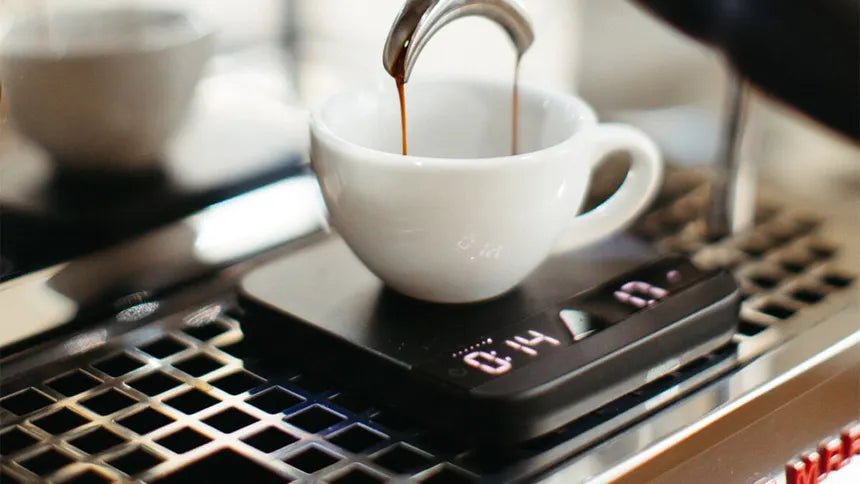
Besides dosing coffee, the scale also serves to measure yield – ideally, you place the cup on the scale under the portafilter (which is why bottomless or single spouts are convenient for all espresso to go into one cup on the scale) and thus monitor how much liquid you get. For a 1:2 recipe, if you put in 18g of coffee, aim for about 36g of beverage in ~25-30 seconds. Without a scale, you rely on volume or time, but each blend flows differently and has different "crema," so a scale provides accuracy. Modern barista scales often have a built-in timer – it helps you track extraction time parallel to weight, which is important for diagnostics (if you get too little or too much in the cup for a given time, you change the grind). Some advanced scales (like Acaia Lunar, Brewista Smart Scale III, etc.) also have auto-tare functions and are waterproof, which is useful because inevitably some drops will spill during practice.
For home use, you can start with more affordable models – it's important that the scale measures to 0.1g and that its platform is small enough to fit under the portafilter/cup in your machine. For example, the Timemore Black Mirror Basic is a popular option, as is the Brewista Smart Scale (with a timer) or the Hario V60 Drip Scale (which has 0.1g precision and a timer, although it's a bit larger). Some espresso equipment manufacturers also offer their own scales – for instance, Eureka Precisa or the Felicita series of scales. Whichever brand you choose, a scale will revolutionize your approach: you'll be able to consistently repeat recipes and more quickly grasp where you have room for improvement in extraction.
Tamping Mat and Other Useful Accessories

Finally, it's worth mentioning the small accessories that make espresso equipment complete. One of them is a tamping mat – a small rubber or silicone mat that you place on the edge of your countertop while tamping. It might seem trivial, but a tamping mat protects your countertop from damage (the pressure from the tamper and portafilter can scratch or dent the surface), and more importantly, it provides a stable and non-slip surface for tamping. This ensures that the portafilter stays firmly in place while you apply pressure, meaning you can evenly compress the coffee with the tamper without fear of the portafilter moving or tilting. Some mats also have an overhang (a vertical "flap") that goes over the edge of the table for added stability and edge protection. An example is the Rocket silicone tamper mat with a vertical flap – practical and high-quality, it fits into any home coffee corner. If you frequently prepare espresso, such a mat significantly contributes to comfort and cleanliness of work.
Other useful accessories include: a dosing funnel – a small ring placed on top of the portafilter while pouring coffee from the grinder, to prevent spills; a knock box – allows quick and clean disposal of used coffee "pucks"; cleaning brushes for the group head and grinder; spare baskets of different sizes (e.g., precise IMS baskets for better flow); and even a thermometer for monitoring extraction or milk temperature if you're making a cappuccino. While these accessories are not strictly necessary for the quality of the espresso itself, they all contribute to easier consistency and cleanliness maintenance, which indirectly affects the taste and pleasure of preparation.
Conclusion: Small Investments for Big Progress
As we can see, with the right tools, anyone can become a home barista who enjoys experimenting and achieving excellent results. Whether you're struggling with bitterness and sourness in the same cup due to channeling, or simply want greater control over every step of preparation, these accessories – from WDT tools, through tampers and distributors, to scales and tamping mats – can make a huge difference. Additional espresso equipment allows you to get the most out of your favourite coffee while enjoying the preparation process like a true barista.
Finally, if you are a passionate coffee lover, try some of these quality tools (many are available in our country, offered by the Brew Society store). With proper use, you will quickly feel an improvement – your espresso will be more consistent, tastier, and closer to that from a speciality coffee shop. Enjoy experimenting and happy brewing of the perfect espresso at home!





Leave a comment
This site is protected by hCaptcha and the hCaptcha Privacy Policy and Terms of Service apply.